
If you enjoy foraging for mushrooms, you may have heard of Turkey Tail. This small but colorful mushroom is famous for its health benefits and beautiful appearance. But finding real Turkey Tail in the wild is not easy. Many mushrooms look similar, and some can be harmful if you mistake them. Knowing how to tell the difference is important for your safety and for getting the right mushroom.
This guide will help you understand how to identify real Turkey Tail (Trametes versicolor) and compare it with its most common lookalikes. You will learn what details to check, what mistakes people often make, and how to feel more confident when you go mushroom hunting. Even if you are a beginner, with careful attention and the right knowledge, you can spot the true Turkey Tail and avoid the fakes. The goal is to help you safely enjoy nature, learn a valuable skill, and avoid common pitfalls many foragers encounter.
Understanding Turkey Tail: What Makes It Unique
Turkey Tail is a type of bracket fungus. It grows on dead or decaying wood, often on fallen logs or stumps. The name comes from its colorful bands, which look like the tail of a wild turkey. These mushrooms are not just pretty; they have been used in traditional medicine for centuries.
What makes Turkey Tail special is not just its look. It also contains polysaccharide-K (PSK), a compound studied for its immune-boosting effects. Foragers and herbalists value it for teas, tinctures, and extracts. However, this popularity means many people search for it—and many get confused by mushrooms that only look similar.
Turkey Tail is also known for its ability to adapt to different environments. It can survive in places with harsh winters or damp, shady woodlands. Unlike some mushrooms that need very specific conditions, Turkey Tail grows in many types of forests and sometimes even in city parks or gardens.
This adaptability is part of why it’s so widespread and well-known.
Another thing that makes Turkey Tail unique is its role in traditional herbal medicine. In countries like China and Japan, extracts from Turkey Tail have been used for hundreds of years to support the immune system and help with recovery after illness.
Modern studies now explore these uses and suggest Turkey Tail may have benefits for gut health, too, because of its high fiber and special compounds. This makes it a mushroom of interest not just for nature lovers, but also for scientists and health enthusiasts.
Why Accurate Identification Matters
Eating the wrong mushroom is risky. Some Turkey Tail lookalikes are harmless, while others can cause stomach upset or even worse effects. Even if a mushroom is not poisonous, using the wrong species for health reasons won’t give you the benefits you want.
Misidentification can happen for several reasons:
- Some mushrooms look almost the same as Turkey Tail from the top.
- Many guides use only color pictures, but colors can change with age, moisture, or sunlight.
- Texture, size, and spore print are often ignored by beginners.
Knowing what to check—and what not to trust—will make your foraging safer and more successful.
Besides the risk of poisoning, using the wrong mushroom may waste your effort. For example, some lookalikes do not contain the same health compounds as Turkey Tail. Even worse, you may collect a mushroom that is tough or bitter, making your tea taste bad or your extract less effective.
In rare cases, using lookalikes in large amounts could lead to allergic reactions. Some foragers have reported skin rashes from handling certain lookalikes with their bare hands.
There is also a legal and ethical side. In some places, foraging the wrong species (especially protected or rare ones) can harm the ecosystem or break local rules. Being accurate with your identification helps protect nature and keeps mushroom foraging a safe, respected activity.

Credit: realmushrooms.com
Where And When To Find Turkey Tail
Turkey Tail grows almost everywhere in the world, including North America, Europe, and Asia. You can find it in forests, parks, and even gardens. It prefers hardwood trees like oak, maple, or beech, but sometimes grows on conifer wood.
The best time to find Turkey Tail is late fall to early winter. However, it can grow all year, especially in wet, cool climates. Older mushrooms from last season may still be on logs, but the freshest ones are easier to identify.
Look for Turkey Tail on fallen branches, stumps, or logs that are starting to rot. In wetter forests, you might find dozens of Turkey Tail clusters on a single log. After heavy rain, new mushrooms sometimes appear almost overnight. In drier regions, Turkey Tail may grow more slowly, and the bands of color can look faded.
One thing many beginners miss is that Turkey Tail often grows on wood that is already soft or crumbly. Hard, fresh-cut wood is less likely to have Turkey Tail. If you see a fallen log with bark peeling off or moss and other fungi growing nearby, it’s a good spot to search.
Sometimes, you might even find Turkey Tail growing alongside moss, lichen, or other small fungi, making foraging more interesting.
For urban foragers, parks with old trees or wood piles can also be good places to look. Just be sure to get permission before collecting mushrooms from public spaces.
Key Features Of Real Turkey Tail (trametes Versicolor)
To tell if a mushroom is the real Turkey Tail, check these features carefully:
1. Bands Of Color
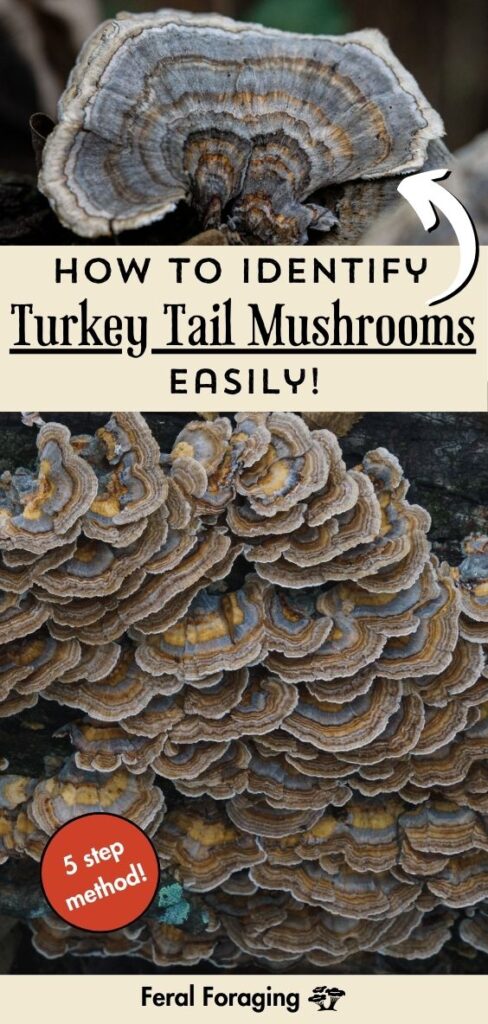
True Turkey Tail has clear, concentric bands of color. These can be brown, tan, gray, blue, orange, or even green from algae. The bands are easy to see and often have a velvet-like surface.
The color bands are sometimes more vivid after rain or when the mushroom is young. With age, the colors may fade, but you should still see at least three or four different shades. If you see only one solid color or the bands are hard to see, look more closely at other features.
2. Thin, Flexible Cap
The cap (top part) is thin, almost like a potato chip, and flexible. It does not break easily. If you bend it, it should flex, not snap.
A good test is to gently try to bend the edge. Real Turkey Tail will bend easily and spring back. If it cracks, feels stiff, or is thicker than a coin, it may be a lookalike.
3. Fuzzy Or Velvety Surface
The top of the cap is covered with very fine hairs. It feels fuzzy or velvety, especially near the edge. Use your finger to gently rub the surface—if it feels smooth or hard, it might not be Turkey Tail.
This fuzziness is most clear on fresh specimens. Older mushrooms or those exposed to heavy rain may lose some of this soft texture, so it helps to check several mushrooms in a cluster.
4. Pores, Not Gills
Look underneath. Turkey Tail has tiny, round pores (like pinholes), not gills or teeth. The pores are white or pale yellow and very close together—about 3 to 8 pores per millimeter.
A magnifying glass helps. If you see thin lines (gills) or the bottom is totally smooth, it is not Turkey Tail. The pores should look almost like the surface of a fine sponge.
5. White Pore Surface
The underside is always white or light cream. If the pores are yellow, brown, or orange, it is probably not Turkey Tail.
Sometimes, the white surface can look a little dirty if the mushroom is old or covered in soil. Try gently brushing it to see the true color.
6. Grows In Rosettes Or Overlapping Shelves
Turkey Tail mushrooms usually appear in clusters. They overlap each other in a pattern, like tiles on a roof or the tail of a bird. They rarely grow alone.
If you see a single mushroom, check carefully. Most real Turkey Tail mushrooms like to form groups, sometimes with dozens packed together.
7. Size
Most Turkey Tail caps are 2–7 cm (about 1–3 inches) wide. They are small, light, and not thick.
If you find a very large shelf fungus (bigger than your hand), it is likely a different species.
8. Spore Print
If you take a spore print (place the cap pore-side down on paper and wait several hours), Turkey Tail leaves a white spore print.
To get a good spore print, use both black and white paper. This way, you can see the color clearly, even if the spores are very light.
Below is a comparison table of these key features:
| Feature | Turkey Tail | Common Lookalikes |
|---|---|---|
| Bands of Color | Always present, clear | Sometimes present, often dull or faded |
| Cap Thickness | Thin, flexible | Thicker, sometimes brittle |
| Cap Surface | Velvety or fuzzy | Smooth or hard |
| Pore Surface | White, tiny pores | Yellow, brown, or large pores |
| Growth Pattern | Clusters, overlapping | Often single or in loose groups |
| Spore Print | White | Varies (often not white) |
Credit: feralforaging.com
Common Lookalikes And How To Tell Them Apart
Many mushrooms look like Turkey Tail from a distance. Here are the most common lookalikes, with tips on how to spot the differences:
1. False Turkey Tail (stereum Ostrea)
This is the most common lookalike. It also grows on wood, has bands of color, and forms rosettes.
Key differences:
- The underside is smooth, not porous. There are no tiny holes.
- The cap is often thinner and more brittle.
- Colors may be brighter but usually feel waxy or smooth to the touch.
If you gently scratch the underside and see no pores—just a flat, smooth surface—it’s likely False Turkey Tail.
Sometimes, False Turkey Tail will stain yellow or orange if you scratch the surface. This reaction does not happen with real Turkey Tail.
2. Violet Toothed Polypore (trichaptum Biforme)
This mushroom is often found on the same logs as Turkey Tail, especially in spring.
Key differences:
- The underside is violet to purple, not white.
- The pores are more like teeth (jagged), not tiny holes.
- The top colors are less varied—often just gray or brown with a violet edge.
If you see purple underneath, it is not Turkey Tail.
As this mushroom ages, the violet color can fade to brown or gray. But the teeth-like structure under the cap remains a good clue.
3. Gilled Polypore (trametes Betulina)
Looks similar on top, but the bottom is very different.
Key differences:
- The underside has gills, not pores.
- The cap may be thicker and more rubbery.
- The surface is sometimes sticky or slimy when wet.
Always check the bottom—if you see gills, walk away.
Gilled polypores are rarely collected for food or medicine, but beginners sometimes confuse them with Turkey Tail because their tops can look similar.
4. Multicolor Gill Polypore (lenzites Betulina)
This mushroom tricks many new foragers.
Key differences:
- The underside has gills, not pores.
- The color bands are less bright and more gray.
- Grows on dead hardwood, like Turkey Tail.
If you run your finger under the cap and feel thin lines (gills), it’s not Turkey Tail.
5. Hairy Curtain Crust (stereum Hirsutum)
A small, hairy mushroom that grows in clusters.
Key differences:
- The top is very hairy, but the underside is smooth (no pores).
- The bands are less clear, often orange or yellow.
- The cap is very thin and brittle.
Check the bottom: smooth means it’s not Turkey Tail.
6. Other Polypores (bjerkandera Adusta, Trametes Pubescens, Etc.)
Some other polypores look similar but are less common.
Key differences:
- The color bands are not as clear.
- The cap is sometimes thicker.
- The pore surface might be gray or brown.
When in doubt, always check for all Turkey Tail features.
Below is a table comparing Turkey Tail with its main lookalikes:
| Mushroom | Underside | Cap Surface | Key Color | Texture |
|---|---|---|---|---|
| Turkey Tail | White, tiny pores | Fuzzy or velvety | Many bands | Thin, flexible |
| False Turkey Tail | Smooth, no pores | Smooth or waxy | Bright, sometimes orange | Thin, brittle |
| Violet Toothed Polypore | Violet, toothed | Smooth | Gray, brown, violet edge | Thin, flexible |
| Gilled Polypore | Gills | Smooth or sticky | White, gray | Thicker, rubbery |
| Hairy Curtain Crust | Smooth, no pores | Very hairy | Yellow, orange | Very thin, brittle |
Step-by-step Guide To Identifying Real Turkey Tail
When you find a mushroom you think is Turkey Tail, follow these steps:
Step 1: Examine The Top
Look for concentric color bands. Use a hand lens or your phone camera to see the small hairs on the surface. The colors should be clear, not faded.
If possible, look for several mushrooms in a group to compare. Sometimes, the youngest mushrooms have the clearest features.
Step 2: Check The Underside
Turn the mushroom over. Use a magnifier if you have one. The underside should be white or light cream with tiny pores. If you see gills, teeth, or a smooth surface, it is not Turkey Tail.
Beginner foragers sometimes miss this step because they focus on the pretty top. Always look at the bottom before picking.
Step 3: Feel The Texture
Gently bend the cap. Turkey Tail is thin and flexible. The surface should feel a little fuzzy, not smooth or waxy.
If you are unsure, compare Turkey Tail with another mushroom nearby. The difference in texture can be very clear with practice.
Step 4: Check The Growth Pattern
Look at the log or stump. Turkey Tail grows in clusters with overlapping caps. If you see only one or two, or if they are far apart, be careful.
Mature clusters can look like a “fan” or a bird’s tail. This pattern is a helpful clue.
Step 5: Take A Spore Print
If you are still unsure, cut a cap and place it pore-side down on white paper. Cover with a bowl and wait overnight. Real Turkey Tail will leave a white spore print.
This is a useful test if you plan to collect Turkey Tail for food or health use. It’s a final check before using the mushroom.
Step 6: Compare With Photos And Guides
Use good-quality guides or trusted websites to compare. Try to look at several pictures, as colors and shapes can change with age and weather.
Some mushroom guides also have drawings or close-up photos of pores and hairs, which are very helpful for learning.
Step 7: Ask An Expert
If you are still not sure, ask a local mycologist, join a mushroom group, or use an online forum. Don’t eat or use any wild mushroom unless you are 100% sure.
Many online groups welcome questions and will help you identify your finds, especially if you include clear photos.

Credit: www.mushroomrevival.com
Common Mistakes Beginners Make
Mistakes are normal when learning, but some can be dangerous. Here are errors to avoid:
- Trusting only the color – Many mushrooms change color as they age or dry out. Always check the underside and texture.
- Ignoring the pore surface – The pores are a key feature. If you do not see them, it is not Turkey Tail.
- Not using all senses – Touch and look carefully. Sometimes, even the smell can help (Turkey Tail is almost odorless).
- Picking old or decayed mushrooms – Older mushrooms may lose features. Try to pick fresh, healthy samples.
- Forgetting the spore print – A white spore print confirms you have Turkey Tail. If you skip this, you may make a mistake.
Another common error is foraging in the wrong habitat. Turkey Tail does not grow on live trees or soil, only on dead wood. If you find a mushroom on the ground, it is likely not Turkey Tail. Also, some people assume that if an animal is eating a mushroom, it’s safe.
This is not true for people, as animals can digest things we cannot.
Beginners sometimes focus too much on one clue (like color) and ignore others (like texture or pores). Practice using all your senses and take your time with each find.
Practical Tips For Safe Mushroom Foraging
Foraging is fun, but safety comes first. Here are some practical tips:
- Always carry a field guide with clear photos and descriptions.
- Bring a hand lens or magnifier to check pores and hairs.
- Use a sharp knife to cut mushrooms cleanly.
- Take photos of the whole mushroom, including where it grows.
- For your first trips, go with an experienced forager.
- If in doubt, leave the mushroom in the forest.
Two non-obvious tips:
- Turkey Tail sometimes has a green covering—this is algae on the surface, not a sign of a different mushroom. The green does not mean it’s not Turkey Tail.
- The bands of color are not always bright. In dry weather or on old mushrooms, the bands can be dull or almost gone. Always check more than one feature.
Another practical tip is to keep a small notebook. Write down where and when you found Turkey Tail and what trees it was growing on. Over time, this will help you find better spots and learn the signs of fresh mushrooms.
Also, bring a small brush to clean off dirt gently before you take photos or collect samples.
If you have pets or children with you, keep an eye on them. Some mushrooms are toxic even to touch or taste, and kids might be curious.
How To Use Real Turkey Tail (if Identified Correctly)
Once you are sure you have real Turkey Tail, you can use it for teas, extracts, or dried for future use. Here’s how:
- Clean the mushrooms with a brush to remove dirt or insects.
- Dry them in a warm place or a food dehydrator.
- Store in an airtight container away from light.
Turkey Tail is too tough to eat like other mushrooms. Most people make tea by simmering dried pieces in water for about an hour. Strain and drink the liquid.
If you want to make an extract, soak the dried mushrooms in alcohol (like vodka) for several weeks, then strain. This pulls out more of the helpful compounds. You can also powder dried Turkey Tail in a blender and add it to smoothies, but remember, the taste is earthy and strong.
Always start with a small amount to see how your body reacts.
Wash your hands after handling wild mushrooms, and never eat them raw. Cooking or making tea helps break down tough fibers and makes the helpful compounds easier to absorb.
Ecological Role And Conservation
Turkey Tail is not just useful for humans. It plays a big role in forest health:
- Decomposition: It breaks down dead wood, returning nutrients to the soil.
- Habitat: Provides food and shelter for insects and small animals.
Do not collect all the Turkey Tail from one area. Leave some for nature and other foragers.
Turkey Tail’s work as a decomposer helps forests renew themselves. Without fungi like Turkey Tail, dead wood would pile up, and nutrients would not return to plants. Some beetles and small creatures live on or inside Turkey Tail, so removing all of it can hurt their habitat.
Be respectful of nature when foraging. Take only what you need and always check local rules—some parks do not allow mushroom picking. Consider sharing your finds with friends or teaching others. This helps create a community of careful, respectful foragers.
Real-world Examples: Case Studies In Identification
Example 1: A False Positive
A forager in Ohio found a cluster of banded mushrooms on oak. The top was colorful, but the underside was smooth. This was False Turkey Tail. He avoided a mistake by checking the pores.
He later brought a sample to a local mushroom club, where more experienced members showed him how to see the difference using a magnifier. This helped him gain confidence for future trips.
Example 2: The Overlooked Underside
A family in Canada collected what they thought was Turkey Tail for tea. After brewing, they felt sick. They later learned the mushroom had gills, not pores—it was a gilled polypore. This shows why checking every feature is important.
The family then decided to join a local foraging group and learned to always check the underside before picking. This simple habit helped them avoid future mistakes.
Example 3: Using A Spore Print
A student found a mushroom matching all Turkey Tail features, but the spore print was yellow. It turned out to be Trametes ochracea, a close relative. She avoided a mistake by taking the spore print.
She learned that even mushrooms that look almost right can be different species. The spore print is a final check, especially if you plan to use the mushroom for food or health.
Scientific Research On Turkey Tail Identification
Scientists use more than just the eye. They may use DNA testing to confirm species. But for most foragers, careful observation is enough. Studies show that misidentification rates for Turkey Tail are as high as 40% among beginners. This shows why it’s important to check all features and not rely on one.
Modern research also looks at the chemical makeup of Turkey Tail. DNA testing has revealed that some mushrooms that look like Turkey Tail are actually different species. This is important for research, but for foragers, sticking to the clear features—color bands, fuzzy top, white pores, and white spore print—gives good results.
Some universities offer short courses or workshops on mushroom identification, which can be helpful for people who want to improve their skills. These courses often use microscopes and chemical tests, but the basics always start with good observation in the field.
For more on the science of mushroom identification, visit the Wikipedia page on Trametes versicolor.
Visual Identification: The Role Of Photography
Taking good photos helps you and others identify mushrooms. To take helpful photos:
- Capture the top and bottom of the mushroom.
- Show the mushroom in its habitat (on wood, in clusters).
- Use a coin or ruler for scale.
You can share these photos with experts or use them to compare later.
Lighting is important—try to take photos in natural daylight, not with a flash, so the colors look true. If you can, get close-ups of the pores, the fuzzy cap surface, and the base where the mushroom attaches to the wood.
These details help with online identification, especially if you ask for help in a mushroom forum or group.
Some foragers make a habit of keeping a photo log. Over time, this creates a valuable record of what you have found and helps you see the differences between Turkey Tail and lookalikes.
Table: Quick Reference For Field Identification
Here’s a quick reference table for your foraging trips:
| Feature | Turkey Tail | What to Watch Out For |
|---|---|---|
| Top Surface | Velvety, with bands | Smooth or sticky |
| Underside | Tiny white pores | Smooth, gills, or teeth |
| Color Bands | Clear and multiple | Faded, dull, or none |
| Growth Pattern | Clusters, overlapping | Single or scattered |
| Spore Print | White | Other colors |
Frequently Asked Questions
What Is The Main Difference Between Turkey Tail And False Turkey Tail?
The key difference is the underside. Turkey Tail has tiny, white pores. False Turkey Tail has a smooth, flat bottom with no pores at all. Always check underneath before picking.
Can Eating A Turkey Tail Lookalike Make You Sick?
Some lookalikes are harmless, but others can cause stomach upset or allergic reactions. Never eat or make tea from a mushroom unless you are certain it is real Turkey Tail. If you feel unwell after eating wild mushrooms, see a doctor right away.
How Can I Be Sure I Have Found Real Turkey Tail?
Check for all key features: concentric color bands, velvety top, thin and flexible cap, tiny white pores underneath, and a white spore print. If you are not sure, ask an expert or use trusted guides.
Is It Possible To Find Turkey Tail All Year Round?
Yes, Turkey Tail can be found year-round in many places. It grows best in cool, moist weather, but old mushrooms can remain on wood for months. Fresh ones are easiest to identify.
Why Do Some Turkey Tail Mushrooms Look Green?
The green color is from algae growing on the surface. This is common and does not mean the mushroom is a different species. The important features (pores, texture) will still match Turkey Tail.
—
Learning to identify real Turkey Tail takes practice, patience, and attention to detail. It is one of the most rewarding mushrooms for foragers and health enthusiasts. By using the steps in this guide, you will reduce your risk of mistakes and enjoy the process more.
Remember, never eat or use any wild mushroom unless you are completely sure of its identity. With time and care, you will become skilled at telling Turkey Tail from its lookalikes—and help keep yourself and others safe.