
Many people love finding mushrooms in the wild. Foragers, hikers, and nature lovers often notice beautiful, fan-shaped mushrooms on fallen trees. One of the most popular is the turkey tail mushroom. It is famous for its colorful bands and health benefits. But here’s the challenge: there’s another mushroom called false turkey tail that looks almost the same. If you want to collect turkey tail for food or medicine, you must know how to tell them apart. Mistaking one for the other is common, even for experienced foragers.
This guide will help you confidently identify real turkey tail (Trametes versicolor) and false turkey tail (Stereum ostrea and Stereum hirsutum). You’ll learn what makes each unique, where they grow, and what features to check. We’ll cover everything from color to texture to spore prints, with photos, tables, and practical tips. By the end, you’ll be able to spot the differences in the field, avoid common mistakes, and feel safer with your wild mushroom finds.
Understanding Turkey Tail And False Turkey Tail
Turkey tail is a well-known polypore mushroom. Its scientific name is Trametes versicolor. The word “versicolor” means “many colors,” a clue to its appearance. Turkey tail is prized in traditional medicine and studied for immune-boosting properties. The false turkey tail group includes species like Stereum ostrea and Stereum hirsutum. They look similar but have important differences. While real turkey tail is safe and useful, false turkey tail is not used for the same purposes.
Let’s start by understanding what sets these mushrooms apart.
What Is Turkey Tail (trametes Versicolor)?
Turkey tail grows on dead or decaying hardwood. It often appears in overlapping clusters on logs, stumps, or fallen branches. The fruiting bodies are thin and fan-shaped, like a turkey’s tail. You’ll notice bands of brown, tan, orange, blue, white, or even green (from algae). The surface is covered with fine, velvety hairs.
Turkey tail’s underside is special: it has tiny, round pores. These pores release spores for reproduction. This is a key feature.
Another detail worth noting is that turkey tail mushrooms can sometimes show green patches on their surface. This green is not part of the mushroom but comes from algae growing on the cap. Many beginners worry that this means the mushroom is old or unsafe.
In reality, the green algae simply show that the mushroom has been in a moist environment for a while. You can still use the mushroom for identification or medicinal purposes.
You may also notice that turkey tail clusters often grow in a rosette or layered pattern, sometimes covering large areas of a log. This layering helps them compete with other wood-decay fungi, giving them more space to release spores and access nutrients.
What Is False Turkey Tail (stereum Ostrea, Stereum Hirsutum)?
False turkey tail also grows on dead wood and forms overlapping clusters. It has wavy, colorful bands, but the colors are usually more muted. The surface may be smooth or slightly hairy, depending on the species. The biggest difference is underneath: instead of pores, false turkey tail has a smooth, flat surface without visible holes.
False turkey tail is not toxic, but it’s not used as food or medicine. It can be tough and tasteless.
It’s also interesting that false turkey tail mushrooms sometimes serve as a home for small insects. If you look closely, you may find tiny beetles or larvae living in the fruiting bodies. This is another clue that these mushrooms are more part of the forest ecosystem than a valuable food or medicinal source for humans.
Some people confuse false turkey tail with other Stereum species. There are several Stereum mushrooms with similar shapes and colors, but none of them have the medicinal uses of real turkey tail.
Key Differences: A Quick Visual Summary
Before we dive into details, here’s a quick side-by-side visual comparison:
| Feature | Turkey Tail (Trametes versicolor) |
False Turkey Tail (Stereum ostrea, S. hirsutum) |
|---|---|---|
| Underside | White to light brown, with tiny pores | Yellow, orange, or tan, smooth (no pores) |
| Surface Texture | Velvety or fuzzy | Smooth or slightly hairy |
| Color Bands | Many colors, strong contrast | Usually brown, orange, tan; less vibrant |
| Spore Print | White | No spore print or pale yellow |
| Edibility/Use | Medicinal, studied for health benefits | Not used for food/medicine |
Notice how the pore surface stands out as the most reliable difference. This is why many experts say, “Flip the mushroom!” before making any decision.
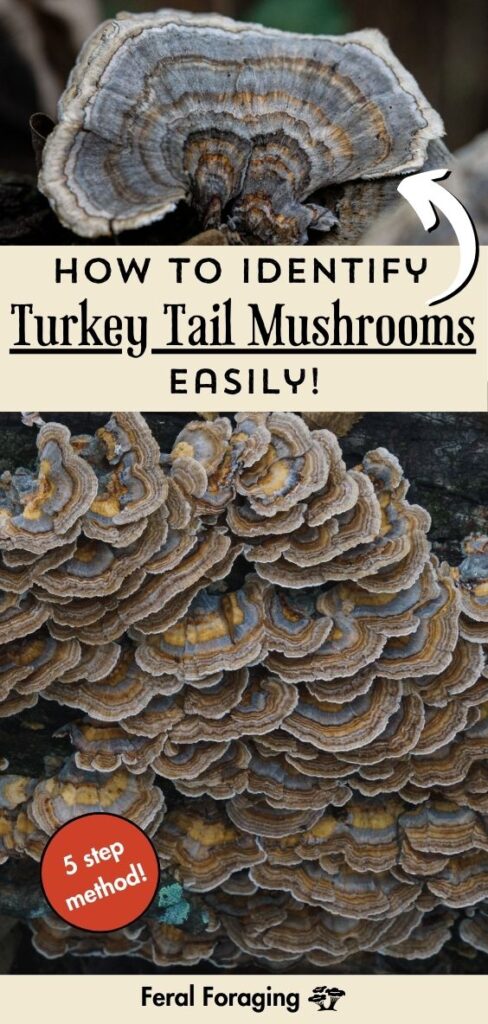
Credit: feralforaging.com
Where And When To Find Turkey Tail And False Turkey Tail
Both mushrooms are saprobic, which means they break down dead wood. You will find them on hardwoods like oak, maple, or beech. Rarely, they grow on conifers. The best seasons are late summer, fall, and sometimes into winter.
Turkey tail and false turkey tail like similar environments. Both like moist, shady forests. They can appear together, making identification tricky.
But there are a few clues:
- Turkey tail prefers well-rotted logs and rarely grows on living trees.
- False turkey tail is often found on freshly fallen wood or branches.
Keep in mind that turkey tail is found across North America, Europe, and Asia. False turkey tail is also common worldwide.
Some foragers notice that turkey tail often grows on logs that have lost their bark, while false turkey tail can sometimes be found on wood that still has bark attached. This is not a strict rule, but it can be an extra clue, especially if you see both types in the same area.
You might also spot turkey tail in urban parks or even in old gardens where logs or stumps are left to decay. False turkey tail, on the other hand, is more often seen in natural forests but can still appear in managed woodlands.
Advanced tip: After a period of rain, both mushrooms can appear in large numbers, sometimes covering almost the entire surface of a downed branch or log. This is a perfect time to practice your identification skills, as you can compare many specimens side by side.
Detailed Visual Identification: Step-by-step
For a confident ID, follow these steps each time you find a possible turkey tail.
1. Examine The Cap Surface
Look at the top of the mushroom.
- Turkey tail: The surface is covered with fine, velvety hairs. When you run your finger across, it feels soft, not slick.
- False turkey tail: The surface may be smooth, sometimes with short, stiff hairs, but often it feels harder and less velvety.
Check for concentric color bands. Turkey tail shows sharp, clear lines between colors. False turkey tail’s bands are less distinct.
A useful trick is to gently blow on the cap. Sometimes, the velvety hairs on turkey tail will move slightly, showing how fine and soft they are. On false turkey tail, the surface usually does not respond to blowing because it is tougher and more compact.
If you look closely (or use a magnifier), you may also see tiny cracks or splits in old turkey tail caps. These cracks are less common in false turkey tail, which tends to dry out without splitting.
2. Check The Color Pattern
Turkey tail mushrooms display a wide range of colors—brown, tan, orange, gray, blue, and sometimes green due to algae. The colors are usually bright and sharply separated.
False turkey tail mushrooms have more muted colors—yellow, orange, tan, brown. The color changes are gradual, not sharply banded.
Beginner’s insight: Sunlight and age can fade colors. Wet mushrooms show stronger colors than dry ones. Don’t rely on color alone.
Sometimes, turkey tail will even show a metallic sheen when the sun hits it at the right angle. This is rare but can help confirm your ID. False turkey tail never has this effect.
If you find a specimen with almost no visible bands, check other features carefully. Both mushrooms can lose their color from weather, so never use color as your only test.
3. Look At The Underside
This is the most important step.
- Turkey tail: Flip the mushroom. The underside is white to light brown and covered with many tiny, round pores. The pores are so small you may need a magnifier or sharp eyesight. You may feel a slight roughness.
- False turkey tail: The underside is smooth and flat. It feels soft and sometimes waxy. There are no pores, only a single, even surface.
Pro tip: Gently scrape the underside with a fingernail. If you see pores opening or flaking, it’s turkey tail. If it stays smooth, it’s false turkey tail.
Another tip: If you have access to a hand lens or a macro camera, take a close-up photo of the pores. Comparing your image to online guides can help build your confidence.
In some cases, the pore surface on turkey tail can look slightly yellowish if the mushroom is old or has absorbed stains from the wood. But the pores will always be visible, unlike the smooth false turkey tail.
4. Look For A Stem
Both mushrooms are bracket fungi, which means they attach directly to wood and rarely have a stem. If you see a stem, it’s likely not turkey tail or false turkey tail.
Some beginners confuse small, stem-like bumps on the edge of clusters with real stems. These are just extensions of the cap and not a true stem. If you see a clear stem, look at other species instead.
5. Check The Spore Print
Making a spore print is a classic mushroom ID method.
- Place the mushroom cap, underside down, on white paper.
- Cover with a bowl to keep it moist.
- Wait overnight.
Turkey tail leaves a white spore print. False turkey tail often does not make a visible print, or it’s pale yellow.
Expert tip: Not all mushrooms will drop spores if they’re old or dry. Try several caps for best results.
For the best results, collect fresh, healthy caps. Sometimes, turkey tail mushrooms that seem dry can still produce spores if you moisten them slightly before making the print. Place them in a slightly damp paper towel for an hour, then try again.
6. Feel The Texture
- Turkey tail: Thin, flexible, and leathery when fresh. It bends without breaking.
- False turkey tail: Thin, but usually tougher and sometimes brittle. It may snap if bent sharply.
With practice, you’ll notice that turkey tail feels almost like suede, while false turkey tail feels more like stiff paper or thin cardboard. This difference is especially clear when the mushrooms are freshly picked.
7. Smell The Mushroom
This is less reliable, but sometimes useful.
- Turkey tail: Mild, earthy, sometimes faintly sweet.
- False turkey tail: Little or no smell, sometimes a faint woody scent.
When you break a fresh turkey tail mushroom, you may notice a gentle, pleasant forest smell. False turkey tail is more neutral or may smell faintly of wet wood.
In-depth: Turkey Tail Vs. False Turkey Tail Species
There are several mushrooms in the “false turkey tail” group. The most common are Stereum ostrea and Stereum hirsutum. Let’s see how each compares to true turkey tail.
| Feature | Trametes versicolor (Turkey Tail) |
Stereum ostrea (False Turkey Tail) |
Stereum hirsutum (Hairy False Turkey Tail) |
|---|---|---|---|
| Cap Surface | Velvety, with fine hairs | Smooth to slightly hairy | Noticeably hairy, bristly |
| Underside | White, with tiny pores | Orange/yellow, smooth | Yellowish, smooth |
| Color Bands | Strong contrast, many colors | Orange, tan, brown (less contrast) | Pale yellow, orange, brown |
| Texture | Flexible, thin | More rigid, sometimes brittle | Tough, can be brittle when dry |
| Distribution | Worldwide, common | North America, widespread | Europe, North America, Asia |
Extra tip: Stereum hirsutum can sometimes feel almost prickly to the touch because of its coarse hairs. If you rub your thumb across the cap, you’ll notice the difference right away.
Stereum ostrea is called “ostrea” because of its oyster-like shape, but don’t confuse it with the edible oyster mushroom (Pleurotus ostreatus), which has gills and a soft, edible texture.
Real-world Field Examples
Let’s look at what you might see in the forest.
- You find a cluster of fans, each 2-4 cm wide, on a log. The surface is velvety with brown, gray, and blue bands. The underside is white, with tiny pores. When you bend the cap, it flexes. This is turkey tail.
- On another log, you find fans with fuzzy, bristly tops and orange, tan, and yellow bands. The underside is pale yellow and perfectly smooth. Bending a cap makes it snap. This is hairy false turkey tail.
Beginner’s mistake: Only checking the top colors. Always flip the mushroom and inspect the underside.
Another real-world example: Sometimes, you might find turkey tail and false turkey tail growing so close together that their caps overlap. In these cases, check each cap carefully. You might even see a transition zone on the wood where the two species meet, each with its own unique features.
If you’re collecting for medicinal use, always take several samples and compare them before deciding which ones to use.
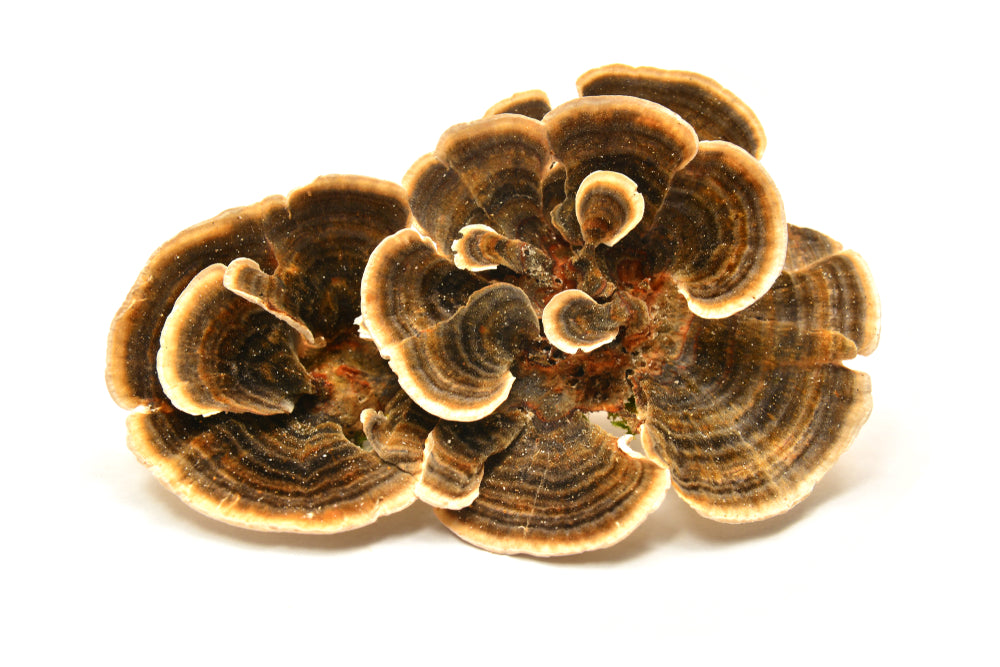
Credit: ommushrooms.com
Common Lookalikes And Other Confusing Species
Besides false turkey tail, several other fungi can cause confusion.
- Lenzites betulina (Gilled Polypore): Has a similar shape but has gills underneath, not pores or a smooth surface.
- Trametes hirsuta: Similar to turkey tail but usually has fewer colors and a hairy, grayish top.
- Bjerkandera adusta (Smoky Polypore): Grayish cap, white pore surface, but usually thicker and less colorful.
When in doubt, compare all features—cap, underside, flexibility, and spore print.
Some field guides also mention Stereum complicatum, a small, orange-banded Stereum that is even thinner than false turkey tail. It also lacks pores.
Tip for avoiding confusion: Take close-up photos of the underside of any lookalike. This will help you remember and compare details later, especially if you’re new to mushroom hunting.
Why Proper Identification Matters
Correctly identifying turkey tail is important for safety and usefulness.
- Medicinal use: Real turkey tail is widely studied for immune support and cancer research. Using the wrong mushroom gives no benefit.
- Taste: Turkey tail is not eaten as a normal food, but is used for teas and extracts. False turkey tail is tough and not useful.
- Safety: Neither mushroom is toxic, but eating wild mushrooms without proper ID can be risky.
Insight: Many beginners assume any colorful, fan-shaped mushroom is turkey tail. This mistake can lead to wasted effort and disappointment.
Another important point is that misidentifying turkey tail can affect your trust in wild medicine. If you collect false turkey tail, make tea, and notice no effects, you might think that all medicinal mushrooms are overrated. In reality, you just need to be sure of your ID.
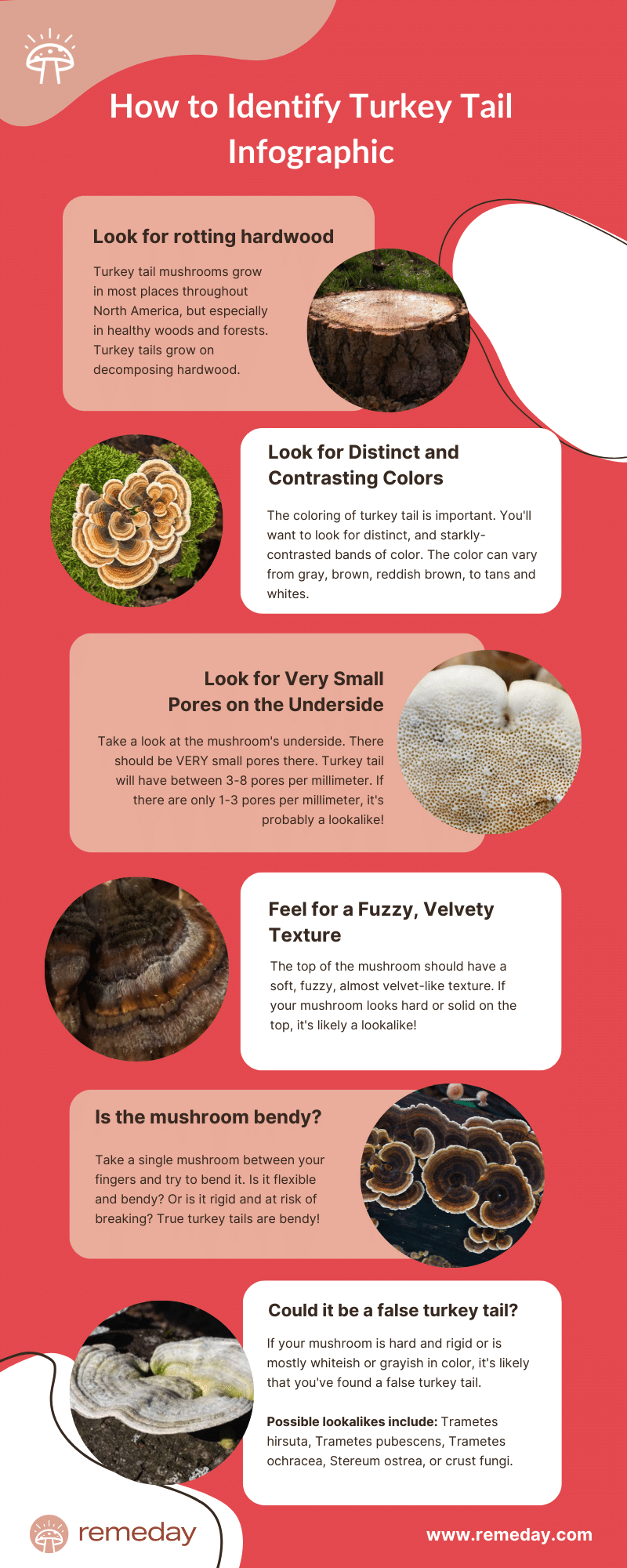
Credit: www.remeday.com
Step-by-step Identification Checklist
Use this quick checklist in the field:
- Find thin, fan-shaped mushrooms on dead hardwood.
- Feel the top—velvety (turkey tail) vs. smooth or bristly (false turkey tail).
- Check color bands—bright and sharp (turkey tail) or dull and blurred (false turkey tail).
- Flip the mushroom. Look for tiny pores (turkey tail) or a smooth surface (false turkey tail).
- Test flexibility—bends (turkey tail) or snaps (false turkey tail).
- Make a spore print if possible—white (turkey tail), yellow or none (false turkey tail).
If all signs point to turkey tail, you can be confident.
Extra field tip: When in doubt, take notes. Write down what you see, and check later with more resources or experts.
In-depth: The Pore Surface
Because the pore surface is the most reliable feature, let’s look closer.
- Turkey tail pores are tiny (3-8 pores per mm), round, and evenly spaced.
- Use a hand lens or magnifier to see them clearly.
- False turkey tail never has pores. The underside is as smooth as a piece of paper.
If you see any gills, it’s not turkey tail or false turkey tail.
Another detail: Sometimes, the pore surface on turkey tail can become stained with brown or green if the mushroom is old or has been wet for a long time. Don’t let this throw you off—just look for the pores.
Other Clues: Growth Pattern And Size
Turkey tail forms overlapping, layered rosettes. Each fan is 2-8 cm wide and 1-3 mm thick. The clusters can cover large areas of wood.
False turkey tail is also layered but tends to form less dense clusters. The fans are usually smaller (1-4 cm).
Field tip: If you see a massive mat of fans, it’s likely turkey tail.
Additional clue: Turkey tail often grows in large groups with fans radiating from a central point, while false turkey tail clusters are more scattered and less organized.
Turkey Tail’s Role In Nature And Medicine
Turkey tail is not just pretty—it’s important.
- Decomposition: Both turkey tail and false turkey tail break down dead wood, recycling nutrients in forests.
- Medicine: Turkey tail contains polysaccharide-K (PSK) and polysaccharide peptide (PSP), studied for cancer and immune therapy in Asia.
- Wildlife: Insects and small animals shelter among the clusters.
False turkey tail does not have the same medical compounds.
In Japan and China, PSK from turkey tail is used alongside chemotherapy for cancer patients. This does not mean you should self-treat serious illnesses, but it shows why correct identification matters.
In the forest, large clusters of turkey tail help create new soil and provide food for tiny insects and even slugs. These roles make both mushrooms important for a healthy forest, even if only one is useful to humans.
Myths And Misconceptions
- Myth: “If it looks like a turkey tail, it’s safe and useful.” Not true—many mushrooms look similar.
- Myth: “Color is all that matters.” In reality, surface texture and the pore layer are much more reliable.
Another myth is that all bracket fungi are turkey tail. In fact, there are dozens of bracket fungi species in every forest. Each has its own features, so careful inspection is essential.
Advanced Tips For Mushroom Foragers
- Carry a small magnifier to check pores.
- Collect several samples—young and old mushrooms can look different.
- Take photos of the cap, underside, and the whole cluster.
- If uncertain, leave the mushroom in place. Never eat wild mushrooms unless 100% sure.
Insight: Sometimes turkey tail and false turkey tail grow side by side. Check every cluster separately.
For more accuracy, you can use a small ruler to measure the size of pores or the thickness of the cap. Details like this help you learn the range of variation in your local mushrooms.
Some advanced foragers use chemical tests (like potassium hydroxide drops) to check for color reactions. This is not needed for turkey tail but can be helpful with other lookalike fungi.
Examples In Scientific Studies
Research shows that many commercial “turkey tail” products are misidentified. DNA testing found that some supplements actually contained false turkey tail species or unrelated fungi. This highlights the importance of accurate identification.
Case study: In a 2017 study, about 30% of turkey tail supplements tested did not contain real Trametes versicolor. This can affect health outcomes and trust in herbal products.
Another study found that visual identification alone is often not enough for dried or powdered mushrooms. For wild foraging, careful inspection and spore prints are your best tools.
How To Document And Share Your Finds
If you want to share your mushroom discoveries:
- Take clear, close-up photos of the top and bottom.
- Note the location (forest type, tree species).
- Record the date and weather conditions.
- Share on mushroom identification forums or apps for extra help.
Posting your finds on platforms like iNaturalist can connect you with experts who may confirm your identification or point out details you missed. This is a good way to learn and become more confident over time.
What To Do If You’re Still Unsure
- Don’t eat or use the mushroom.
- Consult a local expert or mycologist.
- Use online tools like iNaturalist for a second opinion.
- Remember: “When in doubt, throw it out.”
It’s also wise to save a sample (dried or fresh) in a paper bag for further study if you want to learn more later. Never store wild mushrooms in plastic, as they can rot quickly.
Summary Table: Turkey Tail Vs. False Turkey Tail
Here is a final, simplified comparison:
| Feature | Turkey Tail | False Turkey Tail |
|---|---|---|
| Cap Texture | Velvety, soft | Smooth or bristly |
| Underside | White pores | Colored, smooth |
| Colors | Many, bright bands | Muted, blended bands |
| Flexibility | Flexible | Stiff or brittle |
| Spore Print | White | Pale yellow or none |
| Use | Medicinal | Not used |
Frequently Asked Questions
What Is The Main Difference Between Turkey Tail And False Turkey Tail?
The biggest difference is on the underside. Turkey tail has tiny, round pores, while false turkey tail has a smooth, flat surface with no pores. This simple check is the best way to tell them apart.
Can You Eat False Turkey Tail Mushrooms?
False turkey tail is not toxic, but it is tough, tasteless, and not used as food or medicine. Only real turkey tail (Trametes versicolor) is used for health purposes. Always be sure of your identification before using any wild mushroom.
Do Turkey Tail And False Turkey Tail Grow In The Same Places?
Yes, both often grow on dead hardwood in forests. Sometimes you’ll find them side by side on the same log. Careful inspection is needed to tell them apart because they share habitats and seasons.
Are There Other Mushrooms That Look Like Turkey Tail?
Yes. Lenzites betulina (gilled polypore) and Trametes hirsuta are common lookalikes. Always check for pores underneath (not gills or a smooth surface), color bands, and texture to be sure of your identification.
Where Can I Find More Information About Turkey Tail Identification?
For deeper research and more photos, visit the Wikipedia page on Trametes versicolor. This resource offers scientific details, global distribution, and links to medical studies.
—
Knowing how to identify turkey tail and false turkey tail mushrooms is a valuable skill for any forager or nature lover. With careful observation and the right tools, you can enjoy the beauty of these fungi and safely collect the ones you want. Remember: check all features, use a spore print if needed, and never eat a mushroom unless you’re sure. The forest is full of wonders—explore with confidence and respect.