
If you walk through a quiet forest or a shaded park, you might notice colorful, fan-shaped mushrooms growing on fallen logs or tree stumps. These are likely Turkey Tail mushrooms—one of the most famous and easily recognized wild fungi. But with so many similar-looking mushrooms in the woods, how can you be sure what you’ve found is truly Turkey Tail? Correct identification is essential for anyone interested in foraging, natural medicine, or even just appreciating nature. This step-by-step visual guide will help you confidently identify Turkey Tail mushrooms (Trametes versicolor) and avoid common mistakes that beginners often make.
Understanding Turkey Tail Mushrooms
Before you look for Turkey Tail mushrooms, it helps to know what they are and why they matter. Turkey Tail is the common name for Trametes versicolor, a bracket fungus found around the world. The name comes from the mushroom’s colorful, banded surface, which looks like the tail of a wild turkey.
Turkey Tail mushrooms are not only beautiful to look at, but they have an important role in the forest. They help break down dead wood, recycling nutrients back into the soil. This process supports the health of the ecosystem by helping trees and plants grow better.
These mushrooms are famous for their beauty and their use in traditional and modern medicine. They contain compounds like polysaccharide-K (PSK), which is studied for supporting the immune system. In countries like China and Japan, Turkey Tail extracts have been used as part of cancer therapy and immune support for many years. Some people also use the mushroom to make teas or powders, believing it helps general health and energy.
But while Turkey Tail is popular, there are several “lookalike” species that share the same environment, making careful identification essential. Eating or using the wrong mushroom can lead to stomach problems or other risks. That’s why learning to recognize Turkey Tail’s unique features is so important for anyone who wants to collect them.
Non-obvious insight: Even though Turkey Tail grows in many places, the mushroom can look different depending on the forest, climate, and age of the specimen. Some Turkey Tail mushrooms may have faded colors or algae growing on them, making them harder to recognize if you only look for bright, colorful bands.
Where And When To Find Turkey Tail Mushrooms
Turkey Tail mushrooms are widespread and can be found on almost every continent except Antarctica. Knowing where and when to look is the first step in identification.
- Preferred Habitat: Look for them on dead hardwood trees like oak, beech, and maple. They rarely grow on conifer wood. You’ll usually find them on fallen branches, logs, or old tree stumps. Sometimes, they even appear on buried wood, so you may see clusters coming out of the ground near old roots.
- Geographic Range: Found in North America, Europe, Asia, and parts of South America and Africa. In some places, like temperate forests of the United States, you can find them in city parks as well as wild woods.
- Season: Turkey Tail mushrooms can be found year-round, but they are most common in the fall and early winter when the air is moist. After rain or in humid weather, they can appear almost overnight. In mild climates, you might see fresh growth even in late winter or early spring.
Practical tip: Mushrooms growing on living trees or on conifer wood are less likely to be Turkey Tail. If you see a shelf fungus on a pine or spruce, be extra careful before you assume it’s Turkey Tail.
Example: In a city park, you might spot clusters of Turkey Tail on an old, mossy log. In a mountain forest, they may be hidden among the roots of a decaying hardwood tree. Because they break down dead wood, look for Turkey Tail in places where logs are left to rot naturally.
Non-obvious insight: Turkey Tail often returns to the same log year after year. If you find some one season, check back the next year to see how the colony has grown or changed.
Key Features Of Turkey Tail Mushrooms
Let’s break down the main visual features that set Turkey Tail apart from other fungi. Each part of the mushroom offers clues to its identity. Understanding all these features will help you avoid mistakes.
1. Cap Shape And Arrangement
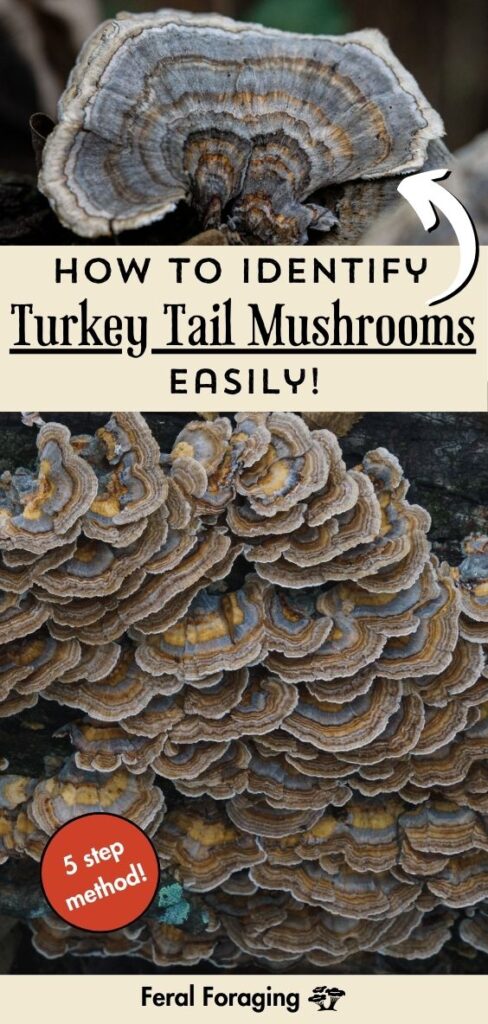
- Shape: Turkey Tail mushrooms have a thin, flat, fan-shaped or semicircular cap. The edge of the cap is usually slightly wavy or scalloped, which adds to their resemblance to a bird’s tail feathers.
- Size: Each cap is usually 2–8 cm wide and 1–3 mm thick. Some clusters can cover a large area of wood, with dozens or even hundreds of caps overlapping.
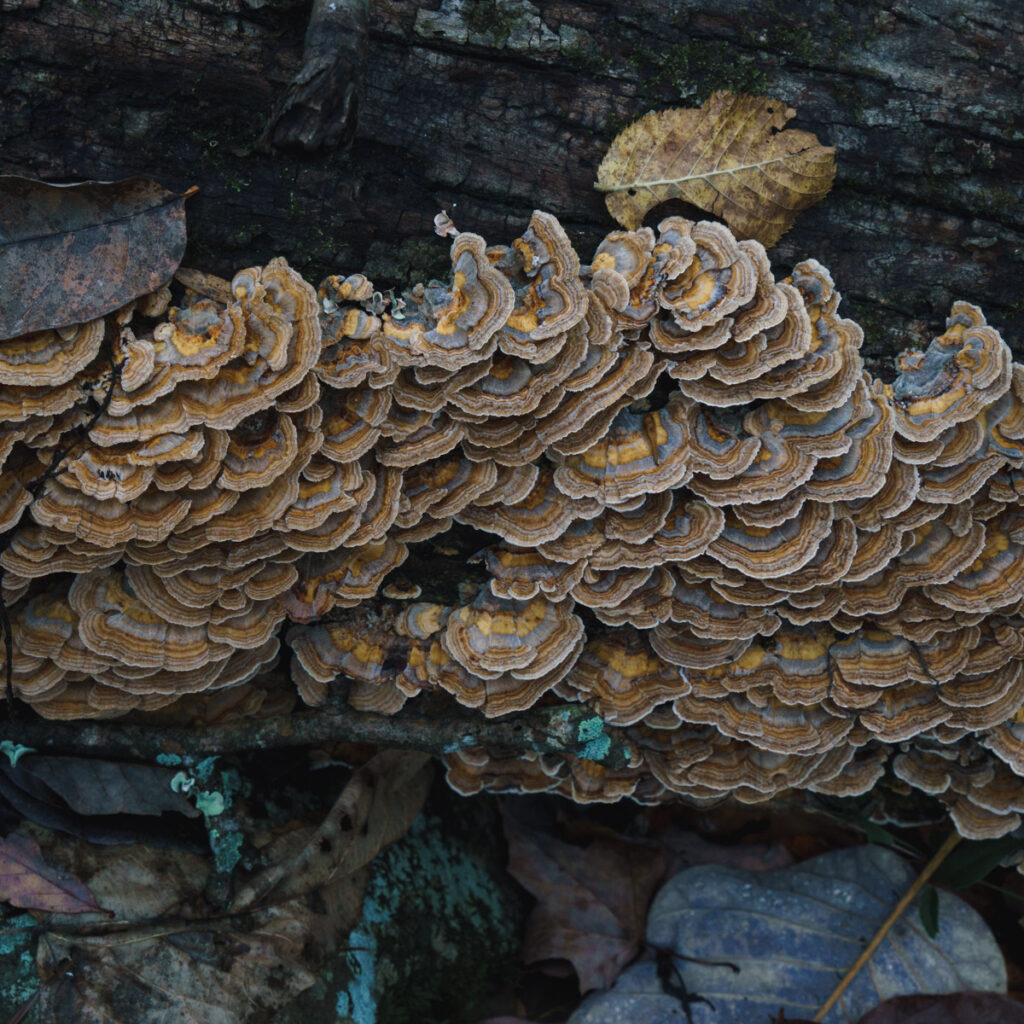
- Growth pattern: They grow in overlapping clusters, often forming rosettes or lines on the wood. The overlapping pattern is a strong hint that you’re looking at Turkey Tail.
Non-obvious insight: Unlike some other shelf fungi, Turkey Tail caps are never thick or cushion-like. If the cap feels spongy or bulky, it’s probably not Turkey Tail. Also, the caps tend to stay close to the wood, without sticking out far like some other bracket fungi.
Example: If you see a single, round, mushroom with a stem, it’s not Turkey Tail. If you see a group of thin, fan-like caps arranged like shingles, you’re probably looking at Turkey Tail.
2. Surface Color And Bands
- Color: The upper surface shows multiple distinct color zones—brown, tan, gray, orange, blue, and even greenish (from algae). The colors can be bold and bright on new mushrooms or pale and faded on older ones.
- Bands: The bands are concentric and clearly separated, making a “striped” appearance. Some bands are smooth, while others are slightly fuzzy.
- Texture: The cap surface is velvety or slightly fuzzy to the touch. You may notice fine hairs if you look closely or use a magnifying glass.
Common beginner mistake: Some similar fungi lack strong color bands or have a smooth, shiny surface. If you don’t see clear stripes or the mushroom feels slick, look again.
Example: A classic Turkey Tail might have dark brown, yellow, and bluish-gray stripes with a velvety touch. If the cap is mostly one color or feels rubbery, it’s likely a different species.
Non-obvious insight: In damp or shady places, a green band may appear on Turkey Tail mushrooms. This is algae growing on the surface, not a sign that the mushroom is unhealthy.
3. Underside: Pore Surface
- Pores, not gills: Flip the cap over. True Turkey Tail mushrooms have a white to cream-colored underside covered with tiny, round pores (6–8 per millimeter). These pores are where the mushroom releases its spores.
- No teeth or gills: There are no gills, ridges, or spines on the underside. Gills look like thin plates, while pores look like tiny holes.
- Pore size: The pores are so small that you may need a magnifying glass to see them clearly. To the eye, the underside looks smooth or slightly rough.
Key detail: If the underside has gills or is smooth, it is not a Turkey Tail.
Example: Pick up a cap and look underneath in good light. If you see a regular pattern of tiny holes, you’ve found a key sign of Turkey Tail.
4. Flexibility And Texture
- Thin and flexible: The cap is thin (like cardboard) and can be bent without breaking when fresh. This flexibility helps Turkey Tail survive in changing weather.
- Not woody: Older caps may become tougher, but never as hard as some polypore fungi. Even dried Turkey Tail is thinner and less woody than many other shelf mushrooms.
Pro tip: If the cap snaps easily or feels as hard as wood, it’s probably a different species. Young Turkey Tail feels almost like stiff paper.
Non-obvious insight: If you harvest Turkey Tail for tea, you’ll notice how quickly it dries out and becomes light and brittle. This is another sign you’ve got the real thing.
5. Attachment To Wood
- Direct attachment: Turkey Tail caps are attached directly to the wood with no stem. They grow out from the surface, hugging the log or stump.
- Clustered: They often overlap, creating a layered effect on the wood.
Observation: If you see a clear stem or the mushroom grows alone, it is likely not a Turkey Tail.
Example: Turkey Tail can cover an entire side of a log, with each cap attached at its base to the wood, overlapping like tiles on a roof.
Visual Guide: Step-by-step Identification
To help you identify Turkey Tail mushrooms in the field, follow this detailed process. Each step focuses on a visual or tactile clue that narrows down your options.
Step 1: Find The Right Substrate
Start by looking for fallen logs, stumps, or branches from hardwood trees. Turkey Tail almost never grows directly out of the ground or on healthy trees. If you find shelf mushrooms on pine or fir, be cautious—they are less likely to be Turkey Tail.
Example: On a walk after rain, check old logs or stumps with bark peeling away. Look for clusters near the ends or sides of the wood.
Step 2: Examine Cap Shape And Arrangement
Look for fan-shaped, thin caps growing in clusters. The caps should overlap like shingles on a roof. Sometimes, you’ll see dozens of caps tightly packed together, with only the edges showing their color bands.
Non-obvious insight: Turkey Tail’s overlapping growth helps it cover as much wood as possible, outcompeting other fungi for space.
Step 3: Check For Colorful Bands
Inspect the upper surface for concentric color zones—brown, gray, tan, orange, and sometimes blue or green. The bands should be clearly defined.
Tip: Use a flashlight or camera flash if you’re in a dark forest. This helps the color bands stand out, especially on old or faded specimens.
Step 4: Feel The Cap Surface
Gently touch the top of the cap. It should feel velvety or slightly fuzzy. A shiny, smooth, or rubbery surface is a warning sign.
Example: If your finger slides easily across the cap, it’s probably not Turkey Tail. If it feels soft and slightly rough, that’s a good sign.
Step 5: Inspect The Underside
Turn the cap over. Look for a white or cream-colored underside covered with tiny pores. No gills or smooth surfaces.
Non-obvious insight: If you’re not sure, gently scrape the underside with a fingernail. If bits of spore dust come off, it’s a polypore like Turkey Tail.
Step 6: Test Flexibility
Bend the cap gently. It should flex without breaking, especially if fresh. Old mushrooms may be more brittle, but still thinner than most woody fungi.
Step 7: Confirm Direct Attachment
Check how the mushroom is attached. There should be no stem; the cap is directly connected to the wood.
Example: If you can see a stalk or the mushroom grows upright like a regular mushroom, it’s not Turkey Tail.
Step 8: Compare With Lookalikes
If you have doubts, compare your find with known Turkey Tail lookalikes (see below). Pay close attention to color, underside, and texture.
Tip: Take clear photos and compare at home, especially if you’re new to mushroom identification.
Common Turkey Tail Lookalikes
Many fungi look similar to Turkey Tail, and some can confuse even experienced foragers. Here are the most common lookalikes and how to tell them apart.
| Species | Key Difference | Underside | Color Bands |
|---|---|---|---|
| False Turkey Tail (Stereum ostrea) | No pores, smooth underside | Smooth, no pores | Similar, but often duller |
| Violet Toothed Polypore (Trichaptum biforme) | Purple edge, toothed underside | Toothed, not pored | Violet, lavender bands |
| Multicolor Gill Polypore (Lenzites betulina) | Gills on underside | Gills, not pores | Similar, but less distinct bands |
| Hairy Trametes (Trametes hirsuta) | Thicker, hairy cap | Pores, but fewer | Grayish, less colorful |
| Thin-maze Polypore (Daedaleopsis confragosa) | Maze-like pores | Elongated, maze-like | Less regular bands |
Key advice: Always check the underside. Turkey Tail is the only one in this group with both a fuzzy, banded cap and a white, pore-covered underside.
Non-obvious insight: Some lookalikes, like Violet Toothed Polypore, are actually edible but taste unpleasant and have no known medicinal use. Others, like False Turkey Tail, are not toxic but have no pores, which is your most reliable clue.
Comparing Turkey Tail To Other Shelf Fungi
To help you visually separate Turkey Tail from similar species, here’s a summary of key features.
| Feature | Turkey Tail | False Turkey Tail | Violet Toothed Polypore |
|---|---|---|---|
| Cap Surface | Velvety, banded | Shiny, banded | Velvety, violet edge |
| Underside | Pores (white) | Smooth (brown) | Toothed (lavender) |
| Flexibility | Thin, flexible | Tough, thin | Brittle |
| Growth Pattern | Clusters, overlapping | Clusters | Clusters |
Example: If you find a mushroom with a violet edge and a toothed underside, it’s Violet Toothed Polypore, not Turkey Tail. If the underside is completely smooth, it’s likely False Turkey Tail.
Credit: feralforaging.com
Mistakes Beginners Make When Identifying Turkey Tail
Many first-time foragers make similar errors when trying to identify Turkey Tail mushrooms. Knowing these can save you confusion and even keep you safe.
- Ignoring the underside: Some lookalikes have a smooth or gilled underside. Always check for tiny, regular pores. Never rely only on the top surface.
- Assuming all banded mushrooms are Turkey Tail: Color bands alone are not enough. Texture and pore structure matter. Some species mimic the look but not the feel or structure.
- Not checking flexibility: Older Turkey Tail can harden, but most lookalikes are either much harder or very brittle. If a mushroom breaks or crumbles easily, look again.
- Overlooking the host wood: Turkey Tail usually grows on dead hardwood. If you find it on pine, be extra cautious. Some lookalikes prefer conifers.
- Missing algae: Sometimes Turkey Tail turns green from surface algae. Don’t let this fool you—check all other features.
- Harvesting old or decayed mushrooms: Old Turkey Tail may lose its colors or get covered in moss, making identification harder. Always check several features, not just one.
Non-obvious insight: Turkey Tail mushrooms can survive through winter and dry weather, so even old, faded specimens may still be identifiable if you check the right features.
Tip: Take notes or photos of your finds. Over time, you’ll build confidence and a library of examples to compare.
Practical Examples: Turkey Tail Identification In The Field
Let’s walk through two real-world examples to show how to apply these steps.
Example 1: Classic Turkey Tail Cluster
You find a group of thin, fan-shaped mushrooms on a dead oak log. The caps show clear, velvety bands of brown, tan, and blue. The caps overlap tightly. When you turn one over, the underside is creamy white and covered with tiny, round pores.
The cap bends without breaking.
Verdict: This is a textbook example of Turkey Tail.
Extra detail: You notice a few green patches on some caps. This is algae, but all other features match Turkey Tail. You feel confident in your identification.
Example 2: Lookalike With A Smooth Underside
You spot a banded, fan-shaped mushroom on a maple stump. The top is colorful and velvety. But when you turn it over, the underside is smooth and brown, with no pores.
Verdict: This is False Turkey Tail (Stereum ostrea), not the true Turkey Tail.
Further observation: The cap feels thin but not as flexible as Turkey Tail. The color bands are less bright. You decide not to harvest this mushroom.
Example 3: Cap With Gills Underneath
On a birch log, you find a mushroom with color bands similar to Turkey Tail, but the underside has gills, not pores.
Verdict: This is Multicolor Gill Polypore (Lenzites betulina). It’s not Turkey Tail—do not use it for tea or supplements.
Credit: feralforaging.com
Advanced Tips For Confident Identification
If you want to go beyond the basics, here are some advanced tips that experienced foragers use.
- Microscope check: Turkey Tail spores are cylindrical and smooth. If you have access to a microscope, you can confirm the species by spore shape. This is rarely needed for most foragers, but it’s useful for science or teaching.
- Chemical tests: Some field guides mention using potassium hydroxide (KOH) on the cap surface, which may change color in Turkey Tail. However, this is not necessary for most people. Only use chemicals if you’re trained and careful.
- DNA barcoding: For scientific accuracy, DNA tests can confirm identity. This is usually done by researchers, not hobbyists. However, DNA testing has revealed that some “Turkey Tail” mushrooms collected around the world are actually different, but closely related, species.
- Photo documentation: Take multiple photos from different angles and lighting. Compare with trusted resources before making a final decision. This helps you learn and share your finds with others.
Pro insight: If you’re ever unsure, leave the mushroom in place. Responsible foraging means only collecting what you can confidently identify.
Extra tip: Join a local mushroom club or nature group. Field trips with experts can teach you more than any book or guide.
Health And Safety Considerations
Identifying Turkey Tail is not only about curiosity—it’s also about safety. While Turkey Tail is non-toxic and often used in teas and supplements, some lookalikes may cause stomach upset or allergic reactions if eaten.
- Never eat wild mushrooms unless 100% sure of identification. Even experienced foragers make mistakes, so always double-check.
- For medicinal use, consult a professional. While Turkey Tail is studied for health benefits, wild-harvested mushrooms can carry pollutants or parasites. Only use them after careful cleaning and proper preparation.
- Harvest sustainably: Only take a small portion from any cluster, leaving most for wildlife and future growth. Turkey Tail is food for insects and helps break down wood.
For more on medicinal mushrooms, you can visit the Wikipedia page for Trametes versicolor.
Non-obvious insight: Turkey Tail mushrooms often absorb pollutants from their environment. If you’re collecting for health, avoid areas near roads, factories, or polluted sites.
Table: Quick Reference For Turkey Tail Identification
Use this summary as a quick field reference to help you make the right call.
| Feature | Turkey Tail | Lookalikes |
|---|---|---|
| Cap Shape | Fan-shaped, thin | Variable, sometimes thick or brittle |
| Color Bands | Distinct, multiple colors | Often dull or irregular |
| Surface Texture | Velvety or fuzzy | Smooth or hairy |
| Underside | Tiny white pores | Smooth, gilled, or toothed |
| Attachment | No stem, direct to wood | Stemmed or irregular |
| Flexibility | Thin, flexible | Hard or brittle |
Frequently Asked Questions
What Are The Main Differences Between Turkey Tail And False Turkey Tail?
The biggest difference is the underside. Turkey Tail has a white, pored surface underneath, while False Turkey Tail is completely smooth and has no pores. False Turkey Tail also tends to have less distinct color bands and a shinier, less fuzzy cap.
Example: If you find a mushroom with beautiful bands but the underside is shiny and smooth to the touch, it is False Turkey Tail.
Can Turkey Tail Mushrooms Grow On Pine Or Other Conifers?
It’s rare. Turkey Tail prefers dead hardwood like oak, beech, or maple. If you find a similar mushroom on conifer wood, double-check all features, as it may be a lookalike or a different species.
Non-obvious insight: Some related Trametes species do grow on conifers but look a bit different. Always check the pores and cap texture closely.
Are Turkey Tail Mushrooms Safe To Eat?
Turkey Tail is not toxic, but it is very tough and woody, so it is not eaten like regular mushrooms. It is often made into teas or extracts for medicinal purposes. Only use wild Turkey Tail if you are 100% sure of your identification, and consult a health professional before using it as a supplement.
Tip: To make Turkey Tail tea, dry the mushrooms and simmer them in water for 30–60 minutes. Strain before drinking. The taste is earthy and mild.
How Long Do Turkey Tail Mushrooms Last In The Wild?
Turkey Tail mushrooms can survive for months or even over a year on the same log. They are resistant to decay and can often be found in all seasons, even after snow or dry weather.
Example: You may see old, faded Turkey Tail on a log in winter and fresh, new growth nearby in spring.
What Should I Do If I’m Not Sure About My Mushroom Identification?
If you are not 100% sure, do not harvest or consume the mushroom. Take clear photos and consult a local expert, mycologist, or trusted online community for help. Responsible foraging means putting safety first.
Non-obvious insight: There are online identification forums and local mushroom clubs where you can share photos and get advice from experts.
Credit: lykyn.com
Final Thoughts
Learning how to identify Turkey Tail mushrooms is a rewarding skill that connects you with the hidden world of forest fungi. By using a step-by-step approach—looking at the cap shape, color bands, surface texture, underside, and growth pattern—you can confidently distinguish Turkey Tail from its many lookalikes.
Remember, it’s never just about the color; the tiny white pores underneath and the flexible, thin cap are key. With practice and patience, you’ll soon be able to spot Turkey Tail wherever you find decaying hardwood. Stay curious, respect nature, and always forage with care.
Bonus encouragement: Start small. Bring a notebook or take photos on your walks. Over time, your eye for detail will grow, and you’ll enjoy every forest walk even more. Happy mushroom hunting!